Free measurement & quote at your place — Book a visit today
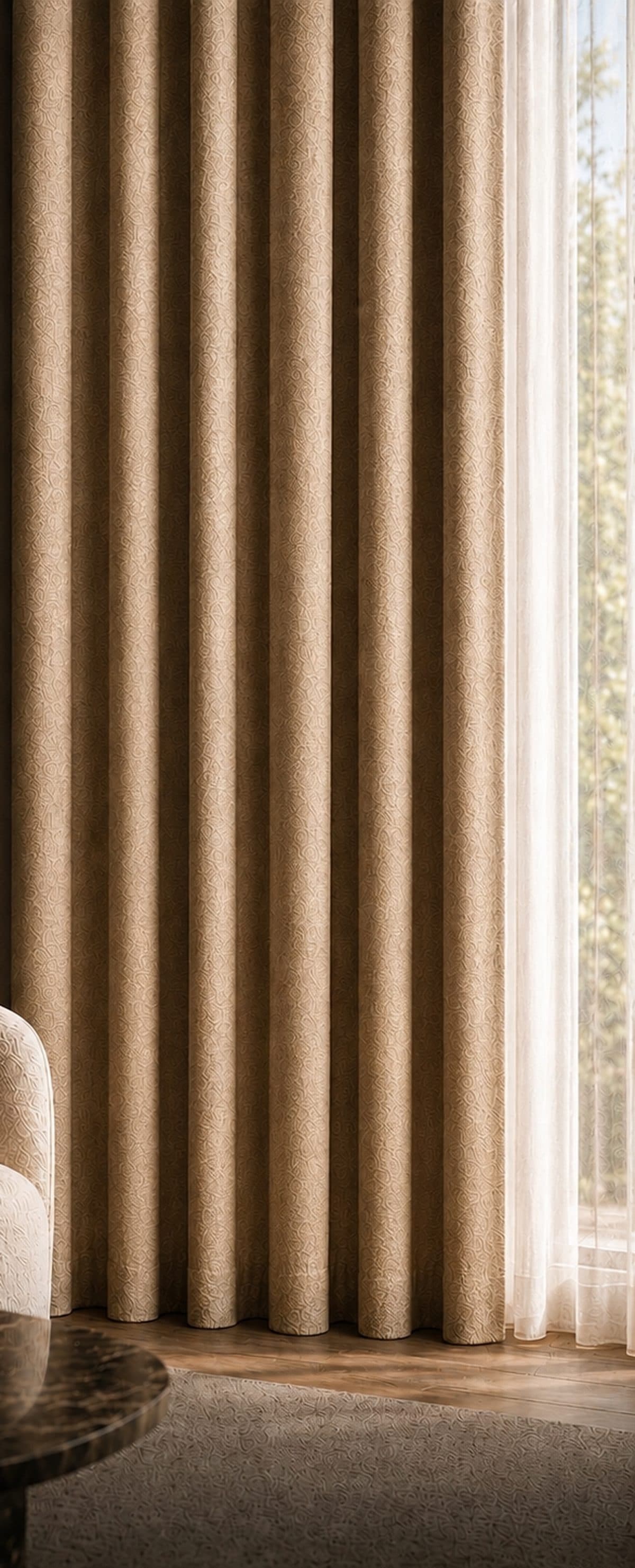
A curtain is the most flexible shading tool you have: it changes a room's light, its acoustics and its temperature at the same time. Because it is cut to the opening, though, the decisions have to be made in the right order — sheerness first, heading second, colour last.
Before anything else, answer one question: how much light should come through when the curtain is closed? That answer sets the fabric category, and it is rarely the same for every room in the same house.
Two curtains made from the same fabric look completely different depending on the heading. It decides how deep the folds fall, how much fabric is needed, and how the curtain stacks at the edge of the opening.
Fabric quantity is measured as a multiple of the width: the larger the multiple, the richer the fold — and the higher the cost. It is the most common reason two quotes differ for no visible reason.
The part nobody looks at on a quote is the part that fails first. A heavy curtain on a light track binds, the user pulls harder, and the runners break.
The track is chosen from the weight of the fabric and the width of the opening, not from the price list. A layered solution — sheer in front, décor behind — needs a double track, which in turn needs depth allowed for in the curtain recess.
Most curtain problems start with a bad measurement. We measure on site, because the drop from track to floor is rarely identical across the width of an opening — and a two-centimetre discrepancy shows.
The measurement is also where we decide where the curtain stops: just clear of the floor, brushing it, or breaking on it. That is an aesthetic choice with practical consequences for cleaning.
It depends on the heading. A simple gather takes less fabric than a wave with a generous fold. We calculate it at the measurement and itemise it in the quote, so you can see what you are paying for.
In some cases yes, with tension mechanisms or a fixing to the frame. They will not hold heavy fabrics, though, and they do not suit wide openings. We assess it on site.
Most modern fabrics wash at 30°C on a delicate cycle, without softener. Linen and some décor weights need dry cleaning. Always follow the label — one wrong wash can shrink a curtain far enough that it no longer reaches the floor.
We come with samples, measure, and give you an itemised quote — no charge, no commitment.
What We Do
Screen, blackout and semi-sheer roller blinds with a clean, modern line and precise control of the light.
See moreHorizontal aluminium or wooden slats, for precise control over the direction of the light.
See moreFabric systems that stack into clean folds — the warmth of fabric without the bulk of a curtain.
See moreElectric mechanisms with a remote or smart control, for openings that are not easy to move by hand.
See moreCleaning, repairs and mechanism replacement — including shading we did not install.
See more